
Exploratory Materials Synthesis and Characterization Group
The discovery of novel device functionalities and new model materials in physical sciences is tightly coupled to design, discovery and growth of novel materials. The core of our program is exploratory synthesis and characterization of quantum materials as well as their advanced synthesis for specialized experimental probes.
While at the microscopic property level all materials are described by quantum mechanics, in quantum materials properties of interest are produced by quantum effects such as topology of electronic wave function, quantum fluctuations, or quantum entanglement and coherence. A common thread in the study of quantum materials is the concept of emergence. Hence, quite often their properties are linked to strong electronic correlations and some type of electronic order.
We make crystals since many physical observables are tensor quantities and since fundamental science can be easily studied in such form by spectroscopy techniques. Moreover, layered and 2D van der Waals crystals provide an avenue for exfoliation, nanofabricaton and device making. An indispensable component of the program is daily round-the-clock rapid feedback of structural, transport, thermal, thermodynamic, and magnetic characterization using in-house instruments, combined with further studies at user facilities.
We currently pursue several interpenetrating research directions.
1. Dirac and Weyl materials
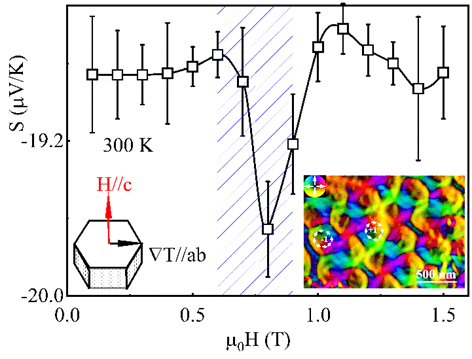
Magnetic field-dependence of thermopower at 300 K upon the application of magnetic field H orthogonal to thermal gradient (left inset). When the skyrmion bubbles form, there is a drop in the value of thermopower. The right inset shows the skyrmion bubbles in color-contour composite image. Skyrmions are induced by rapidly changing magnetic field from 1000 to 11.7 mT. Based on the in-plane spin rotation sense, the topological charge of skyrmionic bubble is determined as ±1. From: Advanced Quantum Technologies 3, 2000058 (2020). |
Dirac and Weyl semimetals will constitute the heart of future devices in many technologies such as photonics, catalysis, electronic, thermoelectric, spintronics or memory. My research group was the first to report quasi two-dimensional (quasi-2D) Dirac fermions in square Bi nets of SrMnBi2 and CaMnBi2 crystals, a step beyond graphene and topological insulators. As stated in Nature Physics review article the roots of topological antiferromagnetic spintronics can be traced to our studies of layered antiferromagnets of the SrMnBi2 – type materials. Since then, we discovered low-dimensional Dirac semimetal state in many crystals of ABX2-type (A = alkaline or rare earth, B = transition metal, X = Bi, Sb, P) with common crystal structure motifs. This pointed to unique powerful inorganic building blocks (synthons) for assembly of Dirac matter in crystals where strong correlations and cooperative phenomena may exist. We have also discovered a series of 3D Dirac and Weyl semimetal states in crystals of ABX family (A = alkaline/rare earth, B = transition metal, X = pnictogen or Ge) which are heavy element compounds with high symmetries and strong SOC interaction. Examples include BaAuSb, SrAgBi and LaAlGe. A common characteristic of all is very small cyclotron mass, of the order of 1/100 of the bare electron mass. Lately, we have shifted our focus to Kagome lattices with Dirac and Weyl states. Ferromagnetic Fe3Sn2 with a geometrically frustrated kagome bilayer of Fe hosts massive Dirac fermions and skyrmionics bubbles at room temperature. Magnetic skyrmions in spin textures of chiral magnets are embodiment of strong correlations and topology. Though crystal synthesis of Fe3Sn2 is difficult due to nearby competing phases and small window of coexistence with the liquid, we have synthesized first crystals of Fe3Sn2. We used these crystals to demonstrate the first room-temperature thermoelectric signature of skyrmion bubbles in a simple thermal gradient and a wide temperature range of skyrmion signature for Kagome interlayer transport along crystal c-axis via topological Hall effect measurement. The results pave the way for future information storage and spin caloritronic devices using skyrmion manipulation by thermal gradients and crystal anisotropy.
2. Iron superconductors
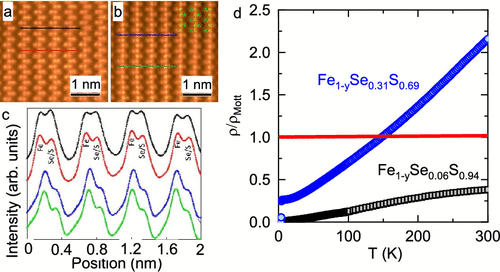
Figure: Left. (a,b) STEM-HAADF images with the incident beam along the [100] direction for (a) Fe1−ySe0.31S0.69 and (b) Fe1−ySe0.06S0.94 single crystals. The [100] projection of the structure model is illustrated in (b) with yellow and green spheres representing Fe and Se/S atom, respectively. Scale bar 1 nm. (c) Intensity profiles (circles) from the scan lines shown in (a,b) with the corresponding colors. The solid lines are the fitted curves based on combined Gaussian and Lorentzian functions. Right: resistivity in S-doped FeSe above the Mott limit. From: Nano Letters 22, 6900 (2022).
|
Past work was focused on discovery of first synchrotron-clean Fe(Te,S) and FeSe crystals, and wide variety of insulating states related to KxFe2-ySe2 superconductors induced by pulsed magnetic field, sulfur substitution on Se atomic site or via engineering of other insulating Fe square (KxFe2-yS2 and K(Fe,Ag)2Te2) or Fe ladder lattices (BaFe2Se3 and BaFe2Se2O). Our recent work is focused on the metallic resistivity at high-temperatures in the presence of strong disorder. There, as a consequence of phonon-unrelated scattering arising from unchanged Fe-Se and Fe-S bond distance lengths in individual FeCh4 (Ch = Se, S) tetrahedra as S substitutes Se in Fe1-ySe1-xSx alloys, resistivity in the normal state at high temperature exceeds the Mott limit. This provides an example of the violation of Matthiessen’s rule and the Mooij law, a dominant effect when adding moderate disorder past the Drude/Matthiessen’s regime in all materials.
3. 2D van der Waals materials
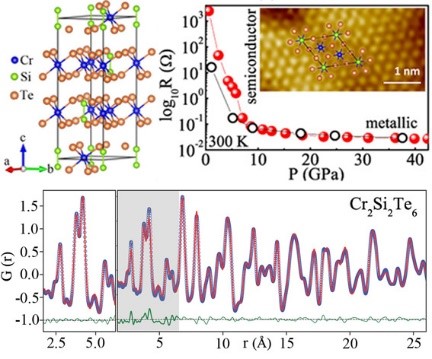
Figure: In flux-grown Cr2Si2Te6 defect-induced short-range order enhances electronic conduction, of interest for spin manipulation by electric current in exfoliated 2D magnetic flakes. ACS Nano 16, 13134 (2022). |
They feature weak van der Waals (vdW) bonds between atomic layers and strong covalent bonds in intralayer atomic units and provide an ideal platform for materials beyond graphene for future electronics. Transition metal dichalcogenides (TMDC’s) and other chalcogenide crystals may host Weyl states and are amenable not only for superconducting but also for spintronic nano- and device-fabrication. My group has had keen interest in chalcogenide vdW materials in the past. We synthesized and characterized magnetic properties and magnetic critical behavior in wide variety of 2D van der Waals (vdW) magnetic crystals; examples include VI3 or Mn3Si2Te6. By introducing nanoscale dislocations and defects via FG crystal synthesis process we were able to enhance conductivity and clarify its mechanism in Cr2Ge2Te6 and Cr2Si2Te6. Work in this area resulted in an invited review article on the magnetic genome of 2D vdW magnets with a team of international experts.
4. Heavy fermions
CeCoIn5’s purity and accessible Tc at ambient pressure enabled rigorous investigation of the long-standing puzzle of high-temperature heavy fermion superconductivity. The discovery of 115 heavy fermion superconductors had considerable impact on the field. Innovative methods of crystal synthesis have resulted in intermetallic crystals with the smallest defect scattering known for any ternary compound. This enabled many landmark scientific experiments that must use very pure and large crystal such as the first measurements of the momentum (k) space structure of the superconducting energy gap Δ(k) for any heavy fermion superconductor, violation of Wiedemann – Franz (WF) law at the Quantum Critical Point, spin resonance and a full breadth of the vortex lattice in a d-wave superconductor. Lately, a combined experiment-theory study revealed a magnetic field-induced Quantum Critical Point and quantum-critical T/B-scaling of the Planckian metal Ce1−xNdxCoIn5 in magnetic fields at xc = 0.03. Meanwhile, the semiconducting gap in heavy fermions is of equal interest as the superconducting gap and for the very same reason: possibility that magnetic interactions are connected with gap formation. Discovery of FeSb2 showed that, besides FeSi, there is a wider class of non-cubic crystals that may be used to study the applicability of Anderson model at half filling with reduced Coulomb repulsion U to 3d transition metal compounds with hybridizing gap. This influenced diverse areas, ranging from the problem of localized – itinerant crossover, hybridization gap and spectral weight transfer involving 4f and/or 3d electrons to thermoelectricity. Discovery of FeSb2 is also important for its thermoelectric (TE) properties. This is because the most favorable TE electronic structure is the one that has a resonance in the density of states centered about 2–3 kBT away from the Fermi energy. Kondo insulators (KI) represent a close approximation of such an ideal case since localized f or d states hybridize with conduction electron states leading to the formation of a small hybridization gap. The density of states just below and just above the hybridization gap becomes very large. The thermopower (TEP) is very sensitive to variations in density of states in the vicinity of the Fermi level hence very large absolute values of TEP can be expected and are reported in KI. Moreover, giant thermopower and giant thermoelectric power factor in FeSb2 can be controlled by metallic flux growth (FG) synthesis-induced vacancies in crystal structure. Small KI-like gaps arise from the formation of covalent bonding/antibonding states and hence it is likely that high thermopower can be found in other materials with similar local crystallography, as exemplified in CoSbS crystals that shares similar local structural units to FeSb2.

Figure: The phase diagram for Ce1−xNdxCoIn5 for B∥c. Tthe antiferromagnetic (AF) Néel state is below the orange area and the superconducting (SC) phase sets in under the blue area (symbols). A QCP is on the doping axis near x ≈ 0.03 at zero field plane, hidden beneath the coexisting phase of the AF and SC phases. At temperature above the SC and AF phases and below the green region, a linear-in-T strange-metallic (SM) behavior occurs. A quantum critical (QC) line (black dotted-dashed line) is expected to exist at finite field and Nd doping, connected to the QCP at zero field, x = xc. |


